
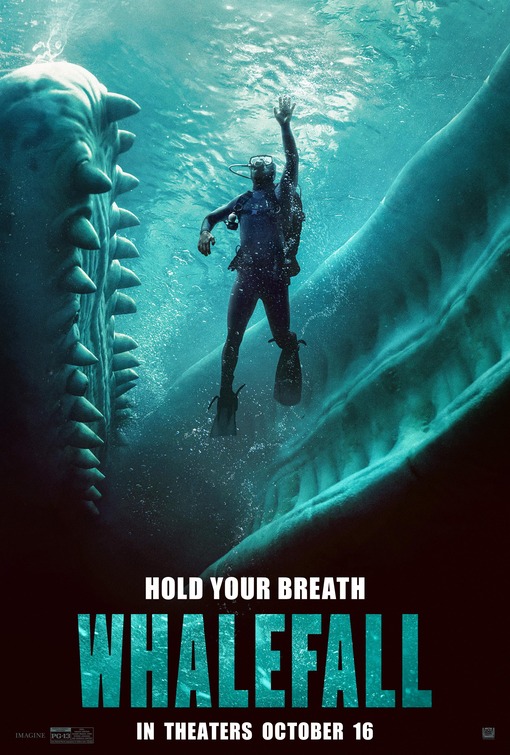
The one thing possibly scarier than encountering a shark in the ocean? Being consumed alive by a sperm whale. Jay (Austin Abrams) returns home one year after the death of his ailing father, the experienced local diver, environmentalist, and survivalist, Mitt (Josh Brolin). Mitt made the decision to die on his own accord rather than have his illness fully immobilize him by throwing himself over the boat during a routine fishing trip. The relationship between the two was contentious, and despite time passing, Jay still can’t muster the strength to read the letter Mitt wrote to him.
Motivated to find his father’s remains, Jay heads to the ocean, geared up to deep dive where Mitt’s friend, Hewey (John Ortiz) said he was last. In descending the ocean depths, Jay is ensnared by a squid, but a sperm whale swallows both the squid, and Jay. Literally in the belly of the beast, and with dwindling oxygen good enough for one hour, Jay must recall everything his demanding father ever told him to find a way out of this scenario.

I cannot be the only one who thought about the Gears of War 2 game chapter of “Intestinal Fortitude” when viewing Whalefall. In that game, the squadron of four gets swallowed by a massive “riftworm,” and they must find their way out by destroying the creature’s multiple hearts, which will then give the team the ability to cut their way out using their chainsaw rifles. Minus the absence of those chainsaw rifles, Whalefall is not too dissimilar. It also has way more on its mind than simple survival.
Tasked with adapting the novel to the big screen is director Brian Duffield, who also co-writes with author Daniel Kraus. The core reason to see this film—watching someone’s desperate attempt to escape from a whale, is elite. Duffield uses CGI, but it’s decidedly less than what you might imagine, largely limited to exterior shots. Nearly everything within the whale is entirely practical from the corrosive, goopy body liquids to the murky, cavernous stomachs, and it all amplifies Whalefall‘s murky claustrophobia. The body horror pushes the PG-13 rating to its limits, and I saw a little homage to Sam Raimi in a handful of extreme close-up shots Duffield uses when Jay is grimacing through the pain and mental anguish. This is a production that is worthy of Oscar consideration for the technical categories, but a few portions of the dialogue are inaudible both in the whale’s mass and outside of it, and left me wishing for subtitles.

Based on all of the trailers and marketing materials (and myself never reading the novel), I expected a straightforward—and mostly exploitative—feature presentation. What’s actually here is quite ruminous and very metaphorical, with Jay being flooded by grief, and needing to make peace in accepting who his father was by embracing the negative, as well as the positive, in order to release himself. Flashbacks are used consistently without becoming pace stoppers. In the final act, Duffield and his cinematographer Aaron Morton create an ethereal sequence blending the literal and the figurative. The length of this scene does push the intention more into hamfistedness than desired, but thankfully, the movie uses an early plot device that allows the penultimate sequence to the climax to work functionally OK enough on both levels.
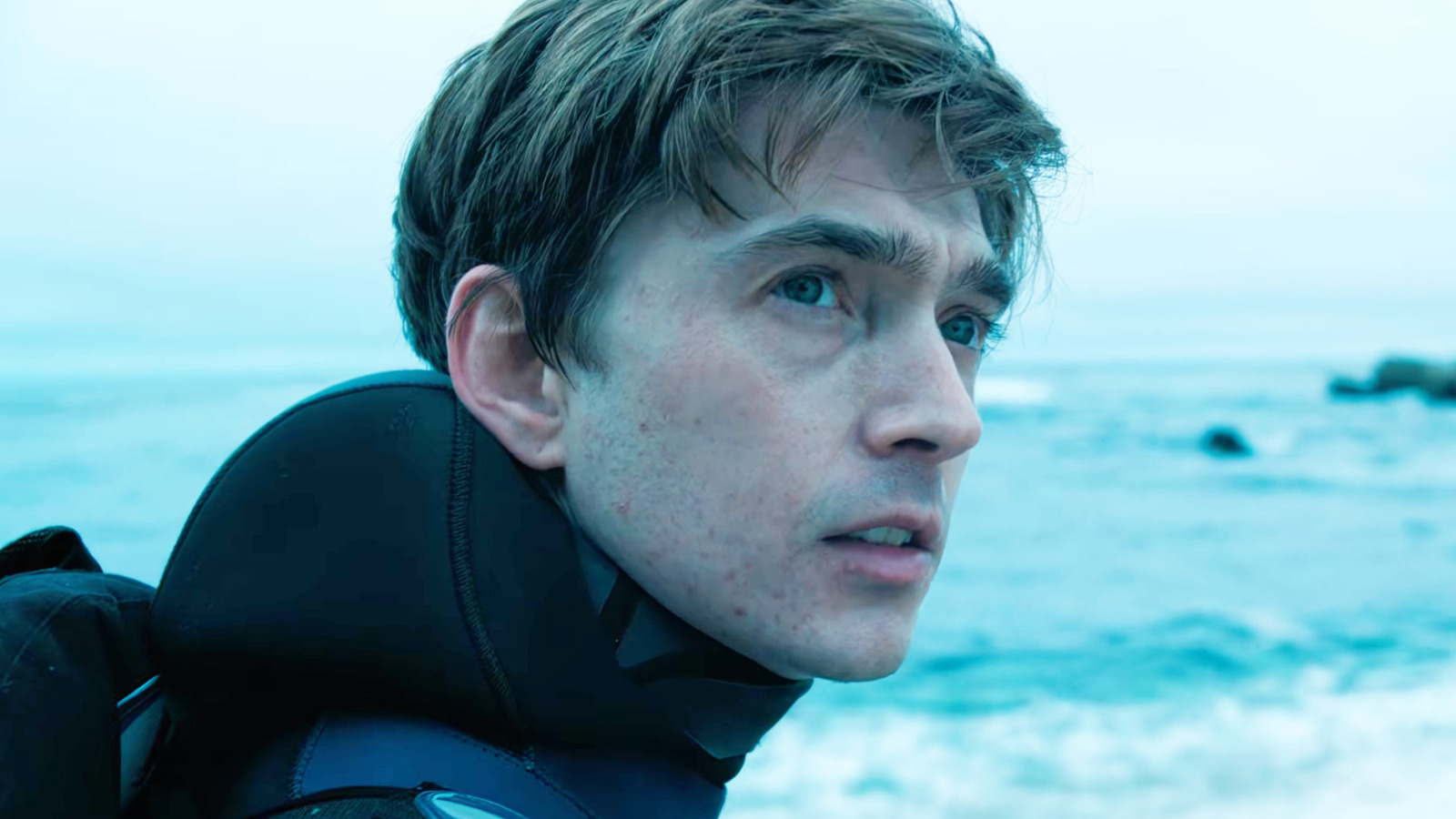
In two vehicles, 2026 has elevated Austin Abrams to a star that is capable of singularly driving a film. If there were a yearly award given to “Best Wilhelm Scream,” his vocals here would cement him as a strong contender for it. In Whalefall, he sells the physicality, exhaustion, and desperation so strongly in every movement and facial expression. Brolin’s Mitt doesn’t get the same amount of character depth Abrams’ experiences, but near the end the film allows him to display more feelings beyond machismo and aggression. It’s a one-hander that moonlights at times as a two hander, which means unfortunately, the women in the film are barely present and have no characterization to speak of.
Nevertheless, Whalefall is a surprise for me. I can’t see it being something I think about too often after this post, or even have the itch to watch again. But I’d recommend it as long as it’s being consumed in a theater, and I think it’s the only way to really be engulfed by the movie’s earnest emotion.
B
Photo credits go to slashfilm.com, impawards.com, hollywoodreporter.com, and vanityfair.com.

