

In The Odyssey, getting home and going home are two entirely different things, the former being physical, and the latter, psychological. Odysseus (Matt Damon), King of Ithaca, has left his throne to be one of the respected leaders of the Greeks in the ongoing Trojan War. The war itself has lasted over twenty years, an agonizing time for the King to be away from his beloved wife, Penelope (Anne Hathaway) and his son, Telemachus (Tom Holland) who was just a toddler when his father went away to war.
The king’s vacancy has created competition to fill the void. Believing Odysseus to be dead, over the last three years disrespectful suitors, led by Antinous (Robert Pattinson), have invaded the palace, vying for the opportunity to become Penelope’s new husband and all the gains that come with being so.
Unbeknownst to anyone in Ithaca, Odysseus is alive after the conclusion of the war. But, his journey home is fraught with peril, whether it be the harsh realities of the gods manipulating Mother Nature, inadvertently provoking battles with more imposing armies and creature behemoths, or through the pain of reconciling with his actions during this 20-year excursion as he attempts to remember exactly what happened to he and his crew during conversation with the enigmatic Calypso (Charlize Theron). If he is able to make it home, he’ll be a forever changed man.

As shared years ago when sharing thoughts on Oppenheimer, famed director Christopher Nolan has been hit and miss for me, as I love a little over half of his catalog, and found (still find) myself cold to the rest. But Oppenheimer was an impressive achievement, one that resonated with me visually, emotionally, and philosophically. As someone who didn’t have the assignment in high school of reading The Odyssey, I’ve come into Nolan’s latest with fresh eyes and experiencing this as a novel story.
Though never reading the books, I’m aware of the fact that transposing The Odyssey’s prose onto the silver screen is no easy feat. The pre-B.C. story has been adapted in many ways, but writer Nolan has opted for a modern style that doesn’t call attention to itself (save for one explicit instance) or feel dramatically out of place for its setting. At his best, his methodical writing builds effectively to thrilling peaks and eventually, strong climaxes.
The Odyssey legitimately gets better the longer the journey goes, and Nolan’s trademark inclination to cross-cut across timelines adds immensely to the combined trepidation, sadness, and longing each of Odysseus, Penelope, and Telemachus carry, and the storytelling framing definitively drives home the psychological exhaustion Odysseus experiences as he is recounting his excursion. Many films, even great films, struggle to land the plane or just keep their foot on the gas once the final act comes, but as this story makes its way back home, the feature accelerates into its last hour, and many of those minor bits of dialogue pay off to create those magical, grinning ear-to-ear type moments in the climax.

Despite never reading the book, it’s inarguable that there is a timeless and enduring quality to The Odyssey. Concepts like Zeus’ Law serving as the approximation for today’s Golden Rule are not cutting edge, but it certainly makes you think about why something so simple and seemingly easy to apply is so difficult to do so. It is fitting that the film directly follows Oppenheimer because the thematic parallels are striking. Both follow a brilliant man reckoning with the aftermath of an intellectual invention—in this case, the Trojan Horse—that marks an irreversible inflection point. Ultimately, it exposes humanity’s willingness to devolve, chasing power at any deceptive or morally compromised cost to win both present wars and the hypothetical ones to follow.
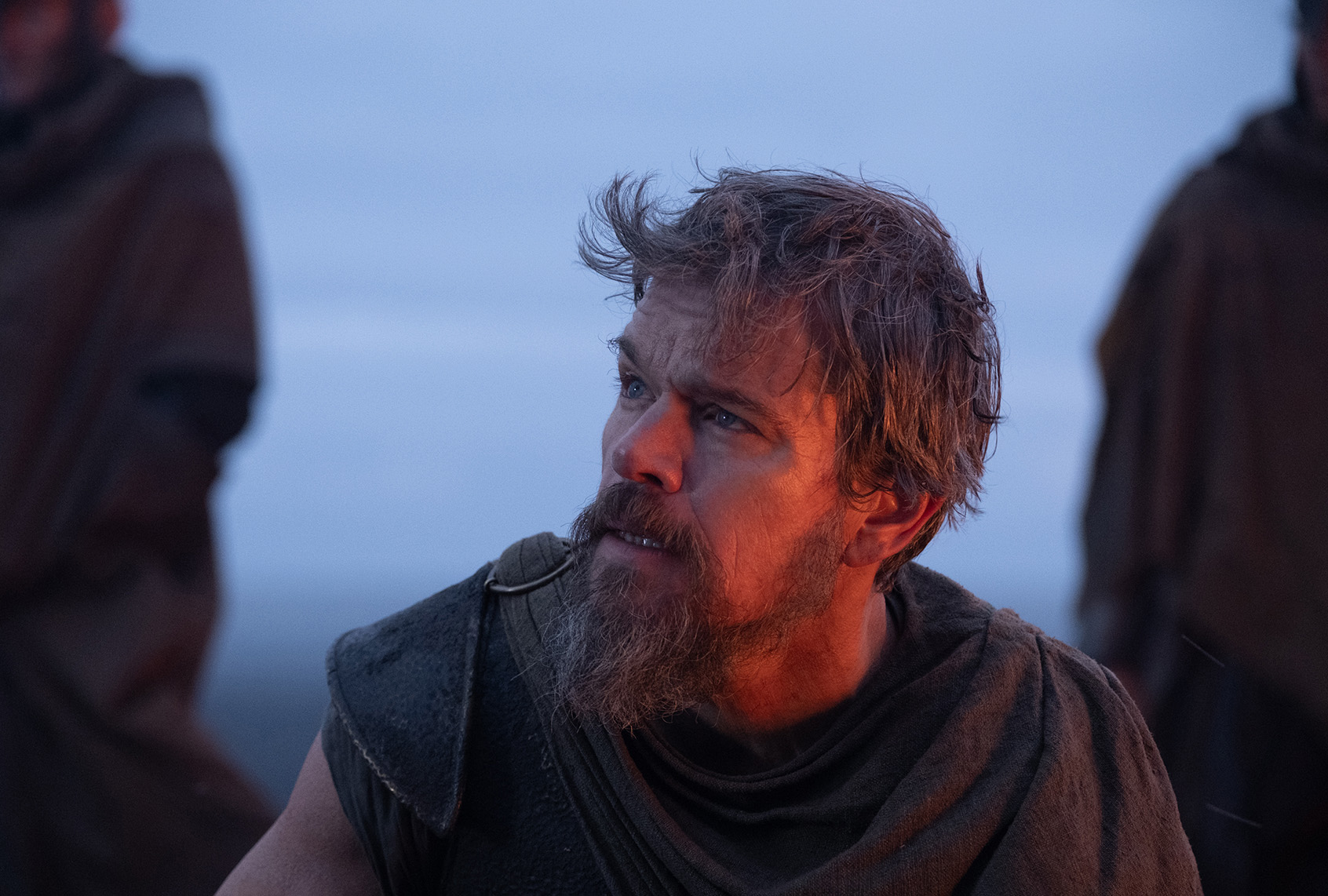
To talk about every notable cast member would make this post extensively longer than it needs to be. But truthfully, I don’t believe there’s a poor performance in the lot, only some that rise to the top tier more than others. There’s been chatter about whether Damon was the right choice for Odysseus and whether it should have gone to Christian Bale, Hugh Jackman, or Leonardo DiCaprio. Odysseus appears to be a character that is moldable and any of those mentioned candidates I have no doubt would have been good. That said, Damon brings enough physicality, the right level of arrogance that never becomes so overdone that he can’t become believable as humbled, and an innate tenderness that I’m not sure the others possess in the same way he does.
Pattinson continues his showcase of range, imbuing Antinous with some comedic lean and a haughty, firecracker aggression. Himesh Patel and John Leguizamo, both in parts that are second-in-command to Odysseus in different ways, give scene stealing performances. In a busy year for Hathaway, her command of Penelope and her ability to make her much more than a queen waiting for her king to return ensures the movie is not lost at sea when not focused on Odysseus. Lastly, while her screen time is miniscule compared to the others listed, Samantha Morton playing a character known as “Cirie” anchors a phenomenally chaotic scene.
All that said, as it often tends to be with his movies, Nolan’s direction and technical support ends up being the number one star of the feature. His eye is deserving of the epic adjective, with every encounter, recollection, etc. either raising the stakes and/or developing Odysseus and his arc further. It’s kind of insane that a stunning sequence featuring a cyclops made with practical effects is the one I’m actually thinking about the least compared to what happens in Morton’s scene and in the underworld of Hades. If we never get a true Nolan horror movie, large swaths of The Odyssey suffice well enough. The only nitpick I can make is on the last action setpiece, which can be too sporadically shaky for my liking. Consistent collaborators in cinematographer Hoyte van Hoytema, editor Jennifer Lame, and composer Ludwig Göransson all ensure that Nolan’s vision is precise, sharpened, and calibrated to elicit the intended effect at any given point in time.
Nolan has long been an event-level director, and the question is, where does he go after The Odyssey? To a lesser extent, similar thoughts were shared after the success of Oppenheimer. I don’t know what he’d choose to tackle next, but whatever he does will carry warranted fever pitch hype, as his last two films helmed directed belong on any best of the decade list.
A-
Photo credits go to impawards.com, salon.com, cinemablend.com, and imdb.com.


Great review, Mark. Couldn’t agree more. I do think that The Odyssey might…might just be Nolan’s finest film of his distinguished career. I found the direction, acting, locations, sound, and editing all masterclass. I would be shocked if the movie isn’t represented in each Oscar category it is eligible for. It is interesting to ponder where his interests will lie next. I haven’t liked all of his films either, but the guy has made some truly awe-inspiring movies. Read these books in school, and really had no strong reaction to them one way or the other. Went to see this movie…and got reeled in to the storyline and action immediately. I cannot wait to see this one again.
In my eyes I really think Nolan’s last two films have been his best ones. I’d probably rank Oppenheimer a bit higher than this one but not by much, The Dark Knight 3 and The Prestige #4. Very much blown away by what he did here and more than deserving of the awards that should come its way.