
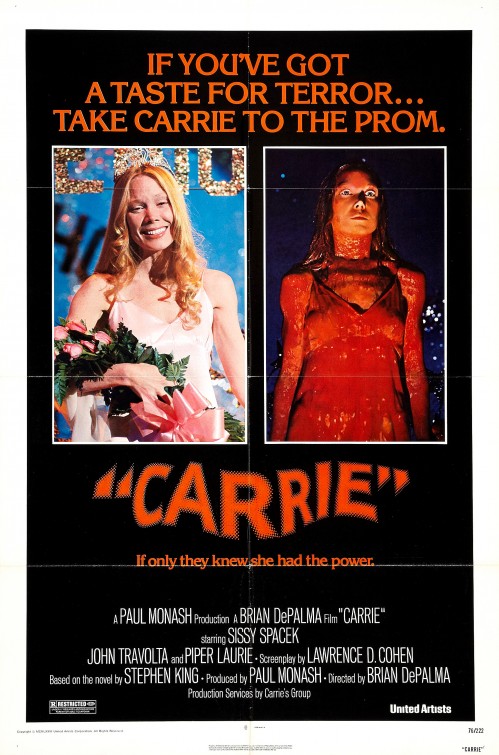
They’re all gonna laugh at you! That line precedes one of the more famous stretches in horror movie history, and really, cinema as a whole. 1976’s Carrie officially turns 50 this year in November, and it’s a seminal moment for so many involved in its creation. What better time than now to revisit it?
THE STORY: It’s the end of senior year, and prom night is fast approaching. For many, it’s the de facto punctuation of high school. But for one student, the ostracized Carrie White (Sissy Spacek), prom is nothing but a pipe dream. Even if she had the confidence to go alone, her relentlessly religious mother, Margaret (Piper Laurie), would never let her. Margaret’s own unresolved issues with the opposite sex have been unjustly put on her daughter, and by putting her into a bubble, Carrie’s mental, emotional, and even physical growth into a young woman has become stunted. This unfortunate reality is seen in the showers after gym class where Carrie gets her first menstrual cycle. Unprepped for this natural bodily function, her classmates, led by the terrorizing Chris Hargenson (Nancy Allen) abuse her verbally and physically, to the point that gym teacher Ms. Collins (Betty Buckley) bars Chris and her friends from attending.
In the aftermath of the gym fiasco, Carrie has discovered she possesses the power of telekinesis when upset. Feeling terrible about her role in tormenting Carrie, classmate Sue (Amy Irving) has encouraged her boyfriend, Tommy (William Katt) to ask Carrie to prom. Uncertain at first about going to prom, Ms. Collins convinces Carrie to go, despite her mother’s warnings about the event. Unbeknownst to Carrie, Chris plots revenge on Carrie once she knows the outcast is attending prom. Unbeknownst to Chris and everyone at prom, Carrie isn’t someone you want to push anymore.

WHAT TO LOOK FOR: While his name is so ubiquitous now, author Stephen King was essentially a nobody 50 years ago. Written in 1974, Carrie was his first novel, and upon its release, it was not a smash hit. Only when the movie came out two years later did sales explode, laying the foundation to launch King into the stratosphere as one of the world’s most prolific and strongest writers, as well as a consistent source of ideas for Hollywood (and television) to go to. It’s impossible to imagine a world of cinema where Stephen King never existed.
Though Carrie wasn’t his first directorial effort, Brian De Palma broke through with Carrie, too. In it, he introduced many of the filmmaking techniques that would be present in most of his features, specifically the split diopter. With Carrie, De Palma positions characters in the foreground and background, rarely in the same room or space (save for one instance), but connects the characters and reveals so much in the way of fear, disdain, embarrassment, or even intrigue, sometimes with limited dialogue. And then, there’s the prevalent use of the color red symbolizing danger, vitality, power, and literal bloodshed whether it’s found during the titular character’s coming-of-age moment, or from the scene plastered on the poster.
I’d be remiss if I didn’t discuss Spacek and the transformation she undergoes from meek outcast to enraged lone wolf, and Laurie, the movie’s biggest villain and oppressor who bears the responsibility of pushing Carrie to what she becomes. But the most intriguing thing to me when watching this movie is how decidedly non-horror-y this feels until those last 20 minutes. Up until then, De Palma and screenplay writer Lawrence D. Cohen take a very patient approach fully dedicated to the point-of-view of Carrie’s, understanding her struggles, inability to fit in, etc., and it makes Carrie resemble something more like a Greek tragedy.

A GREAT MOMENT: No mystery here, it’s the legendary prom scene. Before the destruction, Carrie has seemingly against all odds, become accepted. She and Tommy have been elected prom queen and king, in receipt of overwhelming praise. For Carrie, the last hour or so has been the best night of her life, dancing with her crush, kissing her crush, and finally being looked at as normal. She’s unaware that her ascension has been manufactured by Chris and her friends, and despite Sue’s best efforts to stop the sabotage, it’s for naught.
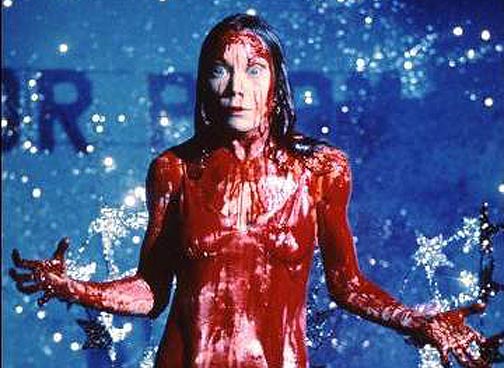
Carrie’s moment is ruined when a suspended bucket of pig blood (obtained in disturbing fashion by Chris and her boyfriend played by a young John Travolta) spills all over her. The empty bucket knocks out Tommy, and Carrie is left alone yet again. Mortified, Carrie hallucinates everyone laughing at her, with the quote her mother said, “They’re all gonna laugh at you!” ringing louder and louder. Seeing the sight of Chris and her best friends planning their escape sends Carrie, telekinesis thoroughly trained, into lethal mode.
The romantic, feel-good buildup to this scene allows the prom moment to work even better, because for one fleeting instance, you can envision what Carrie’s life could be with a traditional upbringing and what she was robbed of. But right before and certainly when the proverbial s**t hits the fan, it’s seven minutes of A+ filmmaking and star acting. From the sound design (silence allows the facial reactions to take center stage) and effects to clue us in when Carrie is using her powers, the giallo-inspired cinematography, the almost trance-like and temperature-rising track of “The Retribution” from composer Pino Donnagio, and the framing from De Palma as he shoots Carrie with a reverence and ethereal quality, it all comes together perfectly. In certain seconds of the mayhem, she looks as if she’s gliding or levitating, transforming into something that’s no longer human. It’s one of the greatest scenes of all time from any genre.
THE VERDICT: 50 years later, Carrie remains the very best film adaptation of King’s first book, one of the best overall Stephen King adaptations, and one of the few horror movies to receive multiple Academy Awards nominations. Nothing else to say, it’s What to Watch as its legacy only continues to grow in stature, and rightfully so.
Photo credits go to impawards.com, Rogerebert.com, nytimes.com, and looper.com.

