
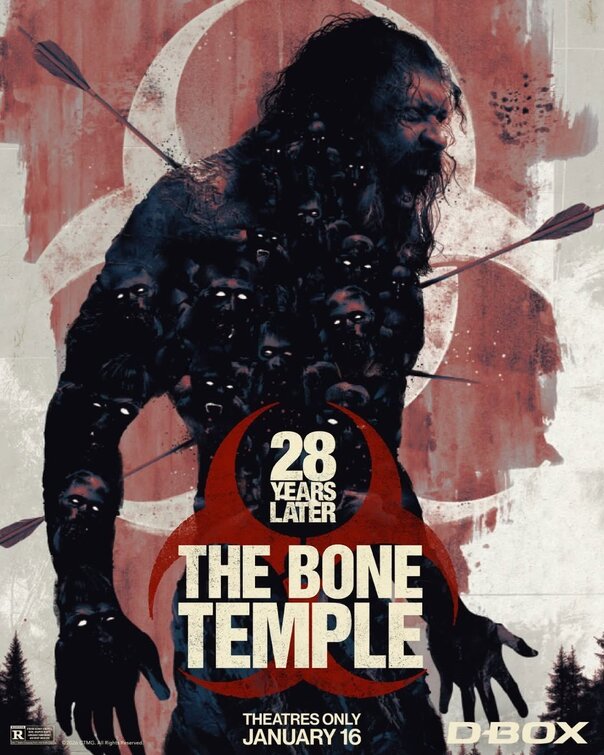
Maybe the Infected are worth fighting for. It’s a deduction made by Dr. Ian Kelson (Ralph Fiennes), caretaker of “The Bone Temple.” Their encounters he has with the alpha, “Samson” (Chi Lewis-Parry), once automatically meant a test of the doctor’s reflexes, his survival predicated on how fast he could shoot morphine-laced darts at the behemoth. The darts would incapacitate Samson and send him in a stupor until the next encounter. But, the doctor is finding that the powerful drug seems to be not only toning down his aggression, but making him more coherent, suggesting an actual cure for the rage virus. Instead of preparing for a standoff, the interactions Kelson and Samson now have evoke more of a brotherhood.
Meanwhile, Spike (Alfie Williams) now finds himself without many options but to join the “Fingers Gang,” led by the gaudy and ruthless leader, Jimmy Crystal (Jack O’Connell). In an apocalyptic hellhole, Jimmy and his disciples—all renamed Jimmy or some close variant to it—bring sadistic slaughter wherever they go. For a man like Jimmy, self-proclaimed as the son of “Old Nick,” his power must be unquestioned, and in order to maintain the hierarchy in his posse, he needs to up the ante, even if that means manufacturing it.

Last year’s 28 Years Later could have taken the easy route and told a similar story most zombie/undead fictional features have taken over the last 10-20 years. But Danny Boyle and Alex Garland would have none of it. 28YL was unafraid to color outside of genre conventions, many of which its first movie introduced. At times, it felt a little grab bag-ey with its ideas, and the ending was so disparate from the rest of the movie, but the narrative swings it took generally connected and provided a compelling launching point for its follow-up, 28 Years Later: The Bone Temple. Through two-thirds of this intended trilogy, it’s clear no movie will feel the same.
Taking on her first horror film since 2021’s Candyman is director Nia DaCosta. Noticeably, and probably intentionally, there’s a missing element of flair and scale that permeated the last movie filmed by Danny Boyle. Whereas 28 Years Later had multiple instances of drone usage, action cameras, and the like, DaCosta’s style is more restrained (at least until the end). It’s not necessarily a bad thing, and the static camera drives home the brutality. These films have always had great music, and in that respect, The Bone Temple has no shortage of top-shelf licensed tracks; Radiohead’s Everything In Its Right Place fits this world beautifully. However, its actual score is the weakest of the franchise, a surprise because of who’s architected it in Hildur Guðnadóttir. After her inspired sound in DaCosta’s Hedda, nothing in the tracklist manages to elevate or accentuate the visual language like Young Fathers’ and John Murphy’s efforts did.

28 Years Later: The Bone Temple directly picks up where 28YL left off. That means we get more of Jimmy Crystal and his gang, necessary after the abruptly jarring ending of the previous movie. Writer Alex Garland’s script sadly minimizes the continued journey of Spike’s coming-of-age story, and by proxy, it weirdly chooses to give no time to Spike’s father Jamie, who has to be searching desperately for his son. But, the choice to fold Spike into a supporting character does allow for two compelling characters in Dr. Kelson and Jimmy Crystal to take center stage.
Each represents the inverse of one another, and it’s no shock that their paths are destined to cross. The way their paths converge is a surprise, and it culminates in a climax that will not be forgotten anytime soon. Thematically, much can be extracted from the story, but the biggest one that sticks for me is a simple one, and it’s the act of compassion and being open-minded, never closing oneself off to find solutions in the bleakest of environments. Perhaps a very small few in this world are beyond saving (i.e. Jimmy), but most can still be reformed and saved, even the most outwardly looking of monsters.
This horror series has always been one that can support many noteworthy performances in the same movie. Co-lead wise, those belong to Fiennes and O’Connell here. Separately they own large stretches of the feature, but the very best moments exist with both sharing the frame. One scene in particular reveals so much about the philosophies of each individual, as well as the extreme psychosis and inadequacies of Jimmy juxtaposed with the empathy and level-headedness of Kelson. Two other castmates shine in secondary efforts. The emerging Erin Kellyman sells her character’s growing doubts of Jimmy’s blind leadership well, and Parry excels as the Alpha. The movie asks a lot of him in driving the emotional beats of the story solely through eyes and physical presence.

I’m finding it difficult to separate 28 Years Later from 28 Years Later: The Bone Temple. The highest of highs are found in 28YL, but I’d say end to end The Bone Temple is more consistent in pace, tone, and what it wants to say. Above all, The Bone Temple gives better assurance by its end that detailed forethought was given to the trilogy, and count me as excited to see what Boyle and Garland do to conclude it.
B
Photo credits go to impawards.com, indiewire.com, digitalspy.com, and gizmodo.com.
 MMJ
MMJ 
I have not seen any of this franchise’s chapters, but after seeing the trailer for this one, I’m pretty confident Fiennes had a blast making this film. I found it interesting you referenced the music in these movies, and that really has me curious about how the soundtracks drive the action.
This one easily has the best soundtrack of the four movies, but the weakest composed score. Without a doubt, Fiennes surely had to enjoy his time with this one.