

Desperation breeds opportunity. In the future, the gap between the haves and the have-nots has only elongated. No matter the environment, everyone lives in a state-run dystopia. Haves reside in their own respective bubbles throughout the nation, have-nots occupy cold, concrete slums, unable to access even the most basic of human needs. One of those have-nots is Ben Richards (Glen Powell), recently fired from his manufacturing job for reporting a hazardous work issue for himself and his co-workers. While noble, the loss of employment leaves him and his wife, Sheila (Jayme Lawson) unable to pay for the medication that will make their daughter’s fever go away.
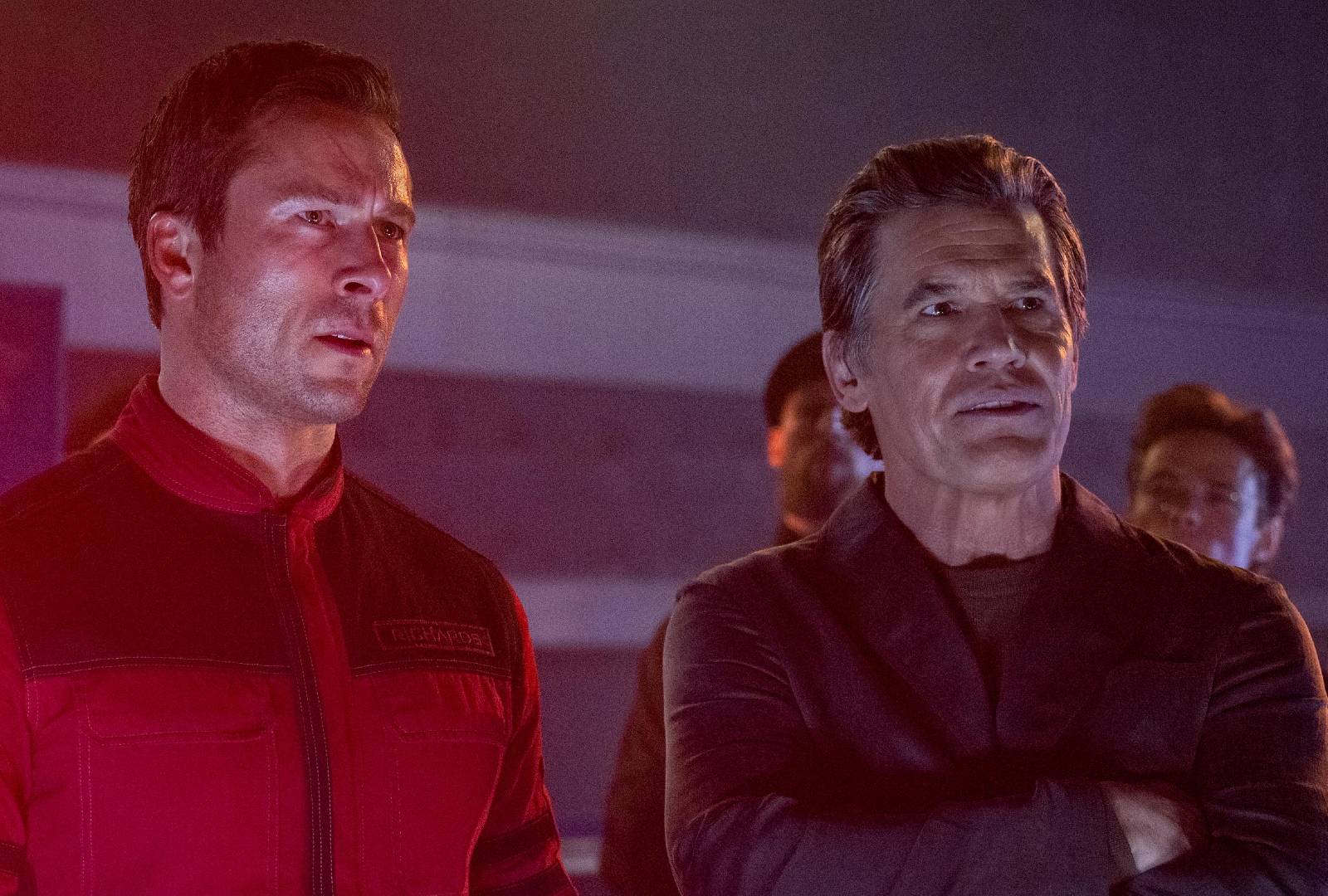
The only way to make it out of this predicament is to play a game, a deadly game. Reluctantly, Ben signs up for The Running Man, a violent show where contestants can earn one billion dollars…if they’re able to survive 30 days being stalked by elite hunters and sold out by wanting citizens needing the money that snitching yields if it leads to a kill. TV producer Dan Killian (Josh Brolin) sees something—viewership and dollar signs—in the angry Richards. Ben is there to play a game, one Dan and his animated host Bobby T. (Colman Domingo) can manipulate for maximum effect. He’ll last, but only as long as Dan needs him to. Yet the longer Ben survives, the more the masses begin to rally around him as he threatens to burn the system to the ground.
1987’s The Running Man has become somewhat reappraised over the decades to follow. Upon release, many found it to be overly violent and repetitive, and opting for a much different direction and tone than the Stephen King penned novel written five years earlier. But that movie did accurately predict an appetite for dumbed-down, reality television and a sort-of “untapped” societal inertia that corporations and governments—perhaps one in the same—could exploit to control, if not the entire masses, large chunks of it. King’s novel took place in 2025, which makes it high time for the movie to get a modern remake. In a nutshell, it’s a little of a better movie than its predecessor, even if it never threatens to be more than solidly good at its peak.
With his oft-energetic style, director Edgar Wright felt like a natural fit to be in the director’s seat of this film. And there are definitely flourishes of the helter-skelter approach that has defined the filmmaker, most evident in The Running Man’s action sequences, the best being a chaotic motel escape arguably serving as the high point of the feature. Occasionally, Wright uses a YouTube conspiracy creator’s videos as a proxy for his own flair. But overall, while the world and environment building is in spades (the decision to set this across the nation over an entire month is an appreciated one), the energy is more muted than his past works, and this gives the updated Running Man somewhat of a flat feeling, especially in areas where you expect his direction to be in simpatico with other technical aspects like the score, a forgettable one composed by oft-Wright collaborator Steven Price.

When The Running Man novel and movie first released in the early and mid-80s, futuristic dystopias, wealth gaps, artificial intelligence, deep fakes, and fake news were still undefined by and large, and not so calcified in other media and even real life. Which is why the latest offering of The Running Man, despite Wright and co-writer Michael Bacall’s best efforts, doesn’t really move the needle in ways that encourage viewers to think any deeper or differently about the themes we’ve become so accustomed to seeing in fiction and living through more and more. Part of that could be due to the movie never fully committing to being wholly comedic or heavier in tone. Just when it looks like it’s about to go full camp and spectacle, there’s a moment where it pulls back and becomes dramatic, and vice versa.
But the biggest error The Running Man makes is being too lengthy, which honestly might be a function of adhering to the source material faithfully. For the first 60-90 minutes, the film moves, paced efficiently and built nicely around strong set pieces and natural plot progression. But once the story finds its way onto a highway and eventually on a plane, the momentum stalls significantly, and the shoehorning in of a character who is so out of place from the remainder of the movie doesn’t help in assuaging that vibe.
Still, this is a fun enough view for most of its runtime, and that’s led first by Powell. This movie relies more on presence than precision performances to get it over the line, and he seems to understand the assignment. The same can be said for veterans Domingo, hamming it up and providing his own turn on the game show host Richard Dawson brought to the original version, and Brolin, highly effective as the manipulative and superior executive producer Dan Killian, eminently punchable from the moment he appears on screen. As far as the rest of the cast goes, few moments exist for anyone to leave an imprint character-wise, they serve in service as essentially NPC’s that Richards must interact with in the world.

In The Running Man, the fun of the journey keeps the film from stumbling over its limitations. At the very least, it’s proof of concept that every dystopian show and silver screen feature doesn’t have to be relentlessly drab and dour.
B-
Photo credits go to impawards.com, vanyaland.com, movieweb.com, and mensjournal.com.
 MMJ
MMJ 
Mrs. B and I saw this last week, and we were disappointed. I liked the first act a bit, buying into the way they set up Glen’s plight and the impact of the network’s influence, but after act one it was not long before I couldn’t wait for the lights to come up. Too long, too talky, and it goes off-the-rails at the end. I thought this was a role perfect for Powell, and I liked him in this.
It does peeter out the longer it goes on and once it gets on the freeway and plane a lot of momentum is lost. I still prefer it to the 1987 version but it’s hard not to feel a little disappointed.