
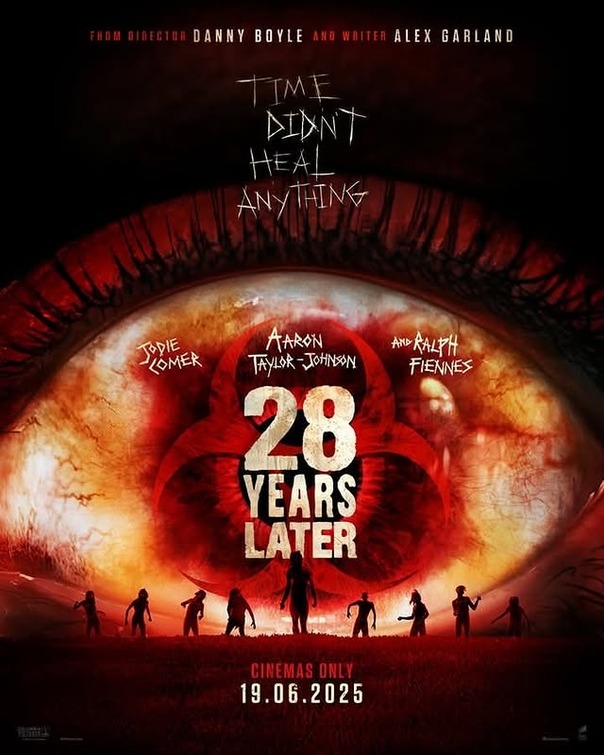
Give enough time to any human, animal, plant, or virus, and it will find ways to evolve and survive. 28 years have passed since the introduction of the Rage virus in the U.K., a terrifying microbe that spreads rapidly through eyes and open wounds by way of blood and saliva from an “Infected.” The Rage virus spread quickly, but somehow was managed to be contained in continental Europe. However, the British Isles are left to fend for themselves in this new world that resembles a very old way of life.
In Lindisfarne is a village where Jamie (Aaron Taylor-Johnson), son Spike (Alfie Williams), and Spike’s mother, a very sick Isla (Jodie Comer) reside. Spike is now 12 years old, and despite being a little younger than usual, he gets clearance to go on his rite of passage, which means going out of the village to hunt and kill Infected with papa. The duo do just that, but are soon fighting for their lives as faster, more nightmarish Infected appear in the area. If the duo are to survive their ordeal, their relationship will be changed and everything Spike was raised to believe will now be tested, forcing him to chart his own path of discovery.

As much as it has expanded, the zombie horror genre hasn’t changed much since director Danny Boyle and writing partner Alex Garland brought a shock to the system back in 2002 with 28 Days Later. 23 years (or 22 if you’re in the U.S.) later, it’s frequently cited as an inspiration for all different types of media, despite famously not being a zombie movie. So how would the duo come back to a genre that is now overpopulated? Put their own spin on it, of course. 28 Years Later is not going to spur a different type of zombie feature moving forward like 28DL did, but despite its shortcomings and unevenness in spots, the movie largely works because of how confident the two are in their approach.
It’s Boyle’s first film in six years, and his first film back in the horror genre since the aforementioned 2002 installment. One of the biggest talking points coming out of this is the decision made to predominantly shoot on iPhone. The choice accentuates the agrestic location, especially when shots are establishing and/or spatial, but there are others where subjects are noticeably blurry in ways a normal setup would mitigate. Still, Boyle and his cinematographer Anthony Dod Mantle create spellbinding moments, whether it’s a tense chase on a causeway during the vast of night, or a pulse-pounding Infected clash where the director uses bullet-time effects highlighting viscera on impact. Creature designs are inspired. Score-wise, John Murphy’s two-movie motif of “In The House” is desperately missed. However, The Young Fathers band craft a couple of standout tracks, including expanding on the “Boots” earworm from the massively successful trailers.

Big narrative swings are taken in 28 Years Later. If expecting a constantly tight, pulse-pounding survival movie against a new horde of evolved zombies…that only exists for the first third of runtime. This is not totally dissimilar to 28DL; that said, Garland’s 28DL script employed a sharper focus when asking whether the monsters are most scariest when they look like us, able to conceal true intentions and abuse power in the wake of societal chaos. Years Later is not only a survival movie, but a coming of age/road trip movie, and a philosophical movie interested in the tie of life and death. And that’s probably only scratching the surface on a first view, both a strength and a detriment. Within these different movies also exist different tones, which affects pacing and consistency. Of course, there’s a much-maligned ending, firmly feeling like it is dropped from a spoof movie into this one.
It’s no easy feat when your first film requires you at 14 years old to carry a lot of the emotional weight, but young Williams rises to the challenge as the fulcrum of the feature. Taylor-Johnson hasn’t been this strong since Nocturnal Animals. While not much to Comer’s Isla due to her character’s affliction, she nonetheless is the conduit for what Garland is saying during one of the feature’s most impactful scenes. Lastly, Fiennes is perfect as the erudite and ostracized doctor, even adding a dash of levity into the dark and post-apocalyptic world.

With the expectations of what consumers have come to appreciate of the saturated zombie genre now, it would have been easy for Boyle and Garland to run it back and release a straightforward, almost The Force Awakens-like soft reboot. They’ve done the opposite in 28 Years Later. Though not every idea connects intricately, their latest installment sets up the series to go in a multitude of different directions, and the best part is we won’t have to wait years to figure out what those directions look like with the 2026 release of The Bone Temple only months away.
B-
Photo credits go to collider.com, impawards.com, cbr.com, and IMDB.com.
 MMJ
MMJ 
This is a thoughtful take. I liked how the film leans into generational perspective through Spike’s coming of age. There’s emotional weight there. Even when the film stumbles, you feel the risk behind each choice.
May benefit from a second viewing for sure.