

It was Gil Scott-Heron who once said that home is where the hatred is. But at the end of the day, home for many of us is still where the heart is, too. For twin brothers Smoke and Stack (Michael B. Jordan), they’ve touched back down in the Mississippi delta in the fall of 1932 after years in Chicago working for crime lord Al Capone. Since chaos always seems tethered to the hip of the duo, it’s hard to tell whether the opportunistic World War I veterans are running from someone or are back to lay down roots. In any event, their return sees them arrive with gobs of cash and a new business plan: Opening a blues juke joint. They get a good deal on the building from a proprietor who might be connected to the KKK, but no matter. This is designed for the African-American community to blow off some steam and be free in the era of Jim Crow.
Opening a club means advertisement, food, music, and security. The twins lean on their network for help. Asian store owners and married couple Grace (Li Jun Li) and Bo (Yao) supply the food and messaging, the estranged wife of Smoke, Annie (Oluwunmi Mosaku) is convinced to cook, field hand Cornbread (Omar Miller) will oversee the front door, and the music will come from town drunkard Delta Slim (Delroy Lindo) and Stack and Smoke’s cousin, the budding guitarist Sammie (Miles Caton), colloquially known as “Preacher Boy.” Young Sammie is eagerly awaiting this day if only just to get away from his God-fearing father for a brief moment. And it wouldn’t be a homecoming if an old flame didn’t re-introduce themselves. Stack’s onetime lover, the biracial Mary (Hailee Steinfeld), immediately makes her presence known.
The twins’ endeavor looks like it may go off without a hitch, until some mysterious—and white—folks look to enter the establishment wanting to share in the communion of music. Rejected but not dejected, their presence as blood suckers will soon reveal itself, leaving Smoke, Stack, and everyone in the club in a fight for their lives.
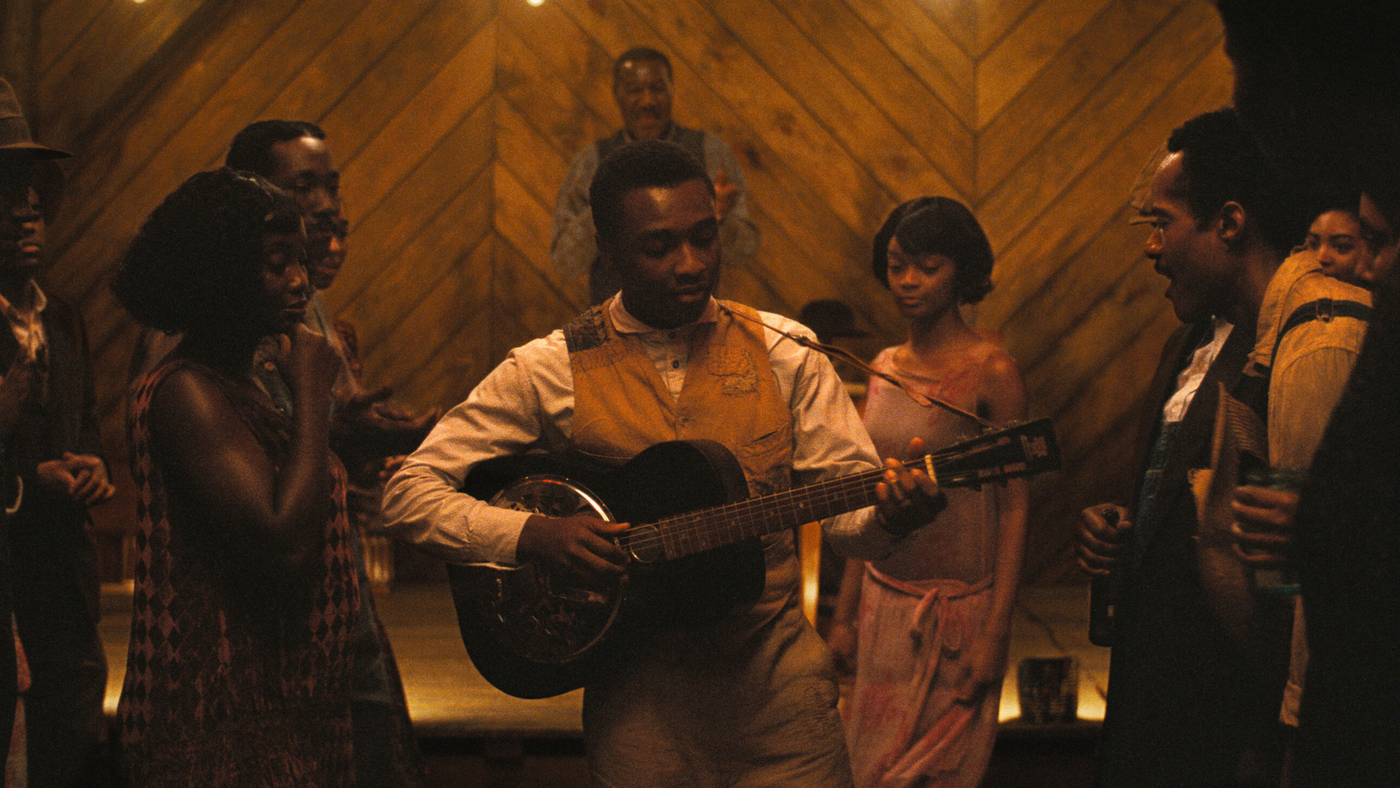
With the talent attached on-screen and off-screen, it would be a surprise if Sinners underwhelmed. Spoiler alert: it does not. But what is so surprising is how effortlessly it moves among genres. It’s really a different movie in every act which often isn’t the best thing. Yet in Sinners, each of these acts interlink with each other so beautifully that the end result makes for something that, even with an film influence it clearly draws inspiration from, feels wholly unique and legitimately special.
For the first time, writer and director Ryan Coogler is the point guard for an original feature. Within minutes, he transports viewers into the early 1930’s Deep South world with an immaculate attention to detail. His visual direction doesn’t shy away from the realities and ever-present fear and oppression, but Coogler is also keen on reminding us that at times, a very rustic, simplistic beauty could be found, too. It’s a setting that is extremely fleshed out and leaves viewers wanting more tales and time spent with these characters. Coogler’s longtime music collaborator Ludwig Göransson impresses again as well, creating a texturally rich musical composition that aids Coogler’s visual storytelling perfectfully. And yes, the scene that everyone’s buzzing about is truly electrifying.

The best films can hit on a straightforward level and a layered one. For Sinners, those looking for an “us versus them” vampire creature feature in the loose vein of Robert Rodriguez’s From Dusk Till Dawn should be satisfied, even if it takes a while to get there. But Coogler’s screenplay is more interested in the themes and questions vampires raise and represent, whether it be assimilation versus separation, or if we’re all in a metaphorical hell where only a select few of us can be free from the powers of principalities or society’s constructs.
Another longtime collaborator of the director in Jordan steps into a dual role and arguably turns in the best work of his career, playing identical twins very integral to the existence of each other but carrying their own distinct personalities, mannerisms, and worldviews. He’s surrounded by a stellar supporting cast giving depth to their characters, from the sensitive and sensual Steinfeld to the world-weary Lindo, and everyone in between. There isn’t a weak link in the film, but it is the debuting Caton who dazzles the most with an aura of confidence and mystique in such an important role to the feature. Come year’s end, he will be on everyone’s breakthrough nominee list.
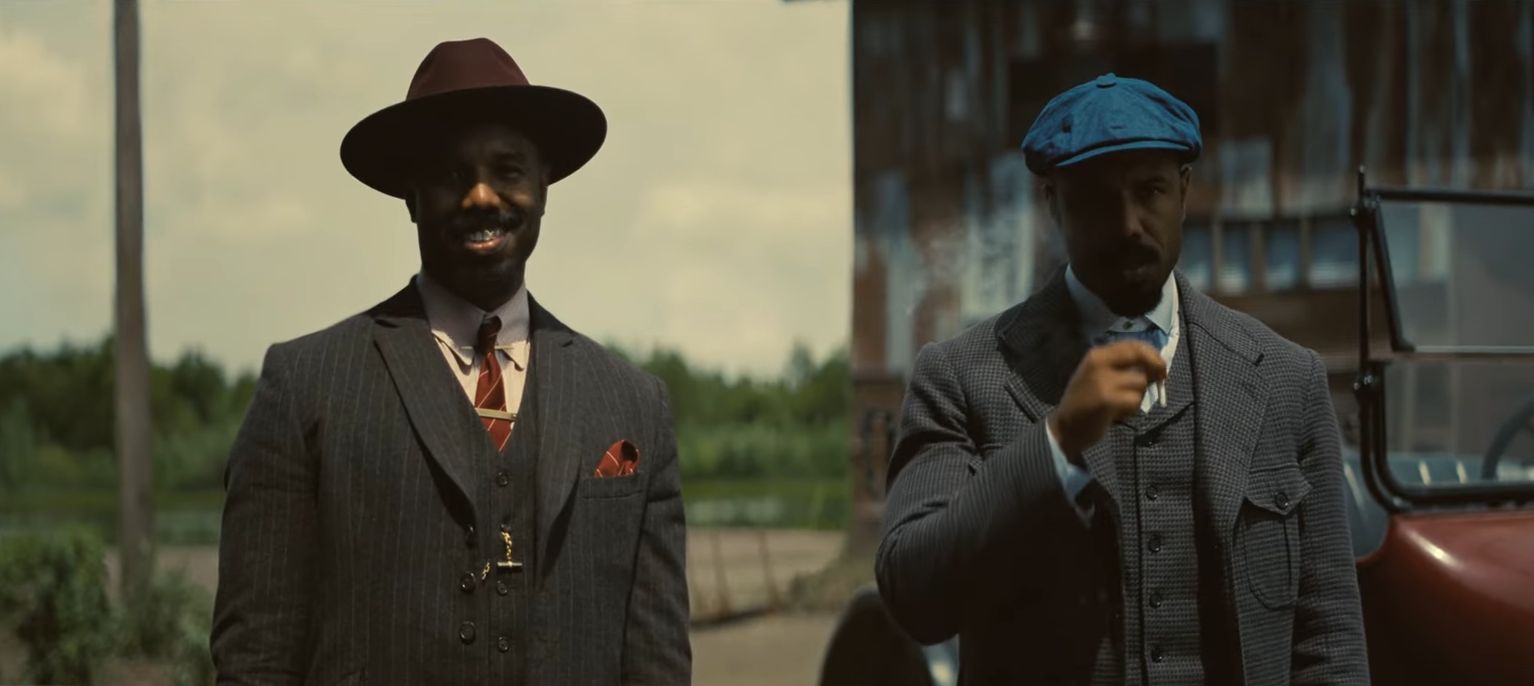
Sinners does and achieves a lot at a high level, and still has people buzzing and thinking about it into its second week of release and likely well beyond, myself included. It has also stamped Coogler as a bona fide event director, and one whose best work may still be in front of him.
A-
Photo credits go to impawards.com, nerdreactor.com, refinery29.com, and vanityfair.com.
 MMJ
MMJ 
Good review. I was quite surprised by this movie. I really didn’t pay much attention to the marketing campaign, so I didn’t know much about the film’s premise. So, I was quite intrigued by the whole vampire angle. Still, the movie worked blending historical setting, character drama, and horror violence into something that was boldly original, which is sort of like a “diamond in the rough”. Great job from Coogler.
Thanks for the comment. Easily my favorite movie of the year so far, still thinking about it consistently.