
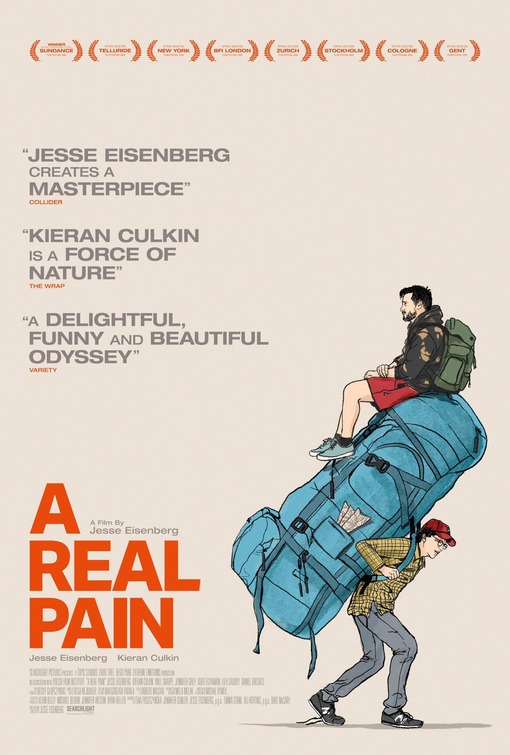
People can’t walk around the world being happy all of the time. There’s a lot of sadness of late in the lives of cousins Dave (Jesse Eisenberg) and Benji (Kieran Culkin). The two, once connected to the hip, have become more distant over the years, with Dave now a career family man, and Benji a bit of a wayward soul. Both are still dealing with the loss of their beloved grandmother in their own ways, but there’s hope that this shared trip to Poland to visit their grandma’s childhood home and reestablish a connection to their Jewish culture can be the ignitor to bringing these two closer again.
Before seeing the home of their deceased loved one, the duo have chosen to take part in a Holocaust tour group. Over the course of a few days, Dave and Benji will be forced to address what has driven them apart, and whether there’s a meaningful path forward for their relationship.
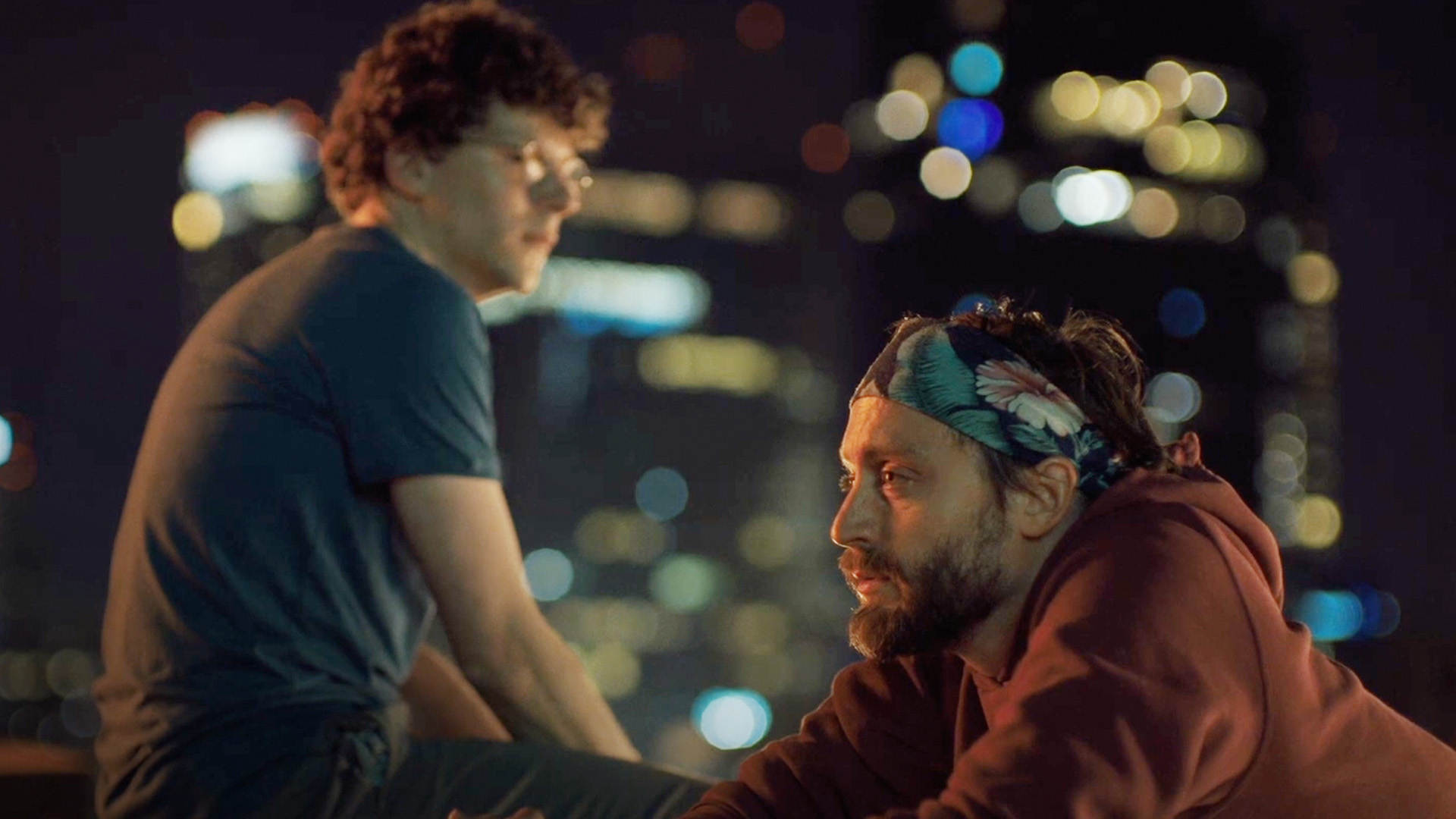
Certainly didn’t have Jesse Eisenberg dropping one of 2024’s more moving releases on my bingo card, but as we rapidly approach the end of the calendar year, here we are. Serving as writer and director of A Real Pain, Eisenberg spearheads a thoughtful examination of two individuals connected by blood working through grief and the troubles of being a grown-up in their own distinct ways.
Eisenberg constructs A Real Pain in a formulaic fashion, using the buddy cop framework for a jumping point into the narrative. His movie is more driven by script than visuals, but the sophomore director leans into steady shots and limited editing during crucial moments, aided by the contributions of editor Robert Nassau. One scene in particular at a dinner table where tragic backstory becomes unloaded is a masterclass in framing and compression. Another presents no words, just the solemn acknowledgement of the historical horrors of the Holocaust. The only decision that doesn’t always gel with the movie is the constant use of classical music in lieu of a more traditional score, as the impressive but recognizable sounds break the immersion from time to time.

Hardship is analyzed in many forms across Eisenberg’s 90 minute film. The natural pain of depression, the discomfort of suppression, and even the pain of third-generation privilege and not feeling connected enough to something that is a part of your fiber. For the latter, you can see the personal connection Eisenberg has to his work. These are heavy themes, and presented in parallel with the Holocaust setting, doubly so. However, his script deftly manages to bring some amusement to the feature in a way that never minimizes the subject matter nor undercuts the tender moments between his leads. All at once, he’s crafted a film that provokes anxiety, melancholy, and cautious optimism upon the conclusion of its runtime.
The delineation between best supporting and lead is hard for a movie like this when the two most important characters are extremely intertwined and spend nearly all of the feature in the same scenes. Nevertheless, Culkin has popped up a lot of end-of-year lists for Best Supporting Actor, and he is quite deserving as the live wire of the pair, operating with a chaotic energy that is equal parts affable and aggravating. His performance is the showier and the more likely of the two to receive and secure accolades, but Eisenberg’s may be the more nuanced, playing an individual who appears so composed and convincing in having it all together while secretly on the verge of breaking down. And though it may not sound all that different on the surface from his turns in The Social Network and The Art of Self-Defense, there’s a wider range of colors in his Dave character than seen in the others.

Balancing a blend of weightiness and whimsicality, A Real Pain establishes Eisenberg as a person to watch behind the camera. His latest effort also reminds us that with the right (self-created) stuff around him, he can still be a force in front of the camera, too.
B+
Photo credits go to impawards.com, maxblizz.com, ign.com, and rottentomatoes.com.
 MMJ
MMJ 