
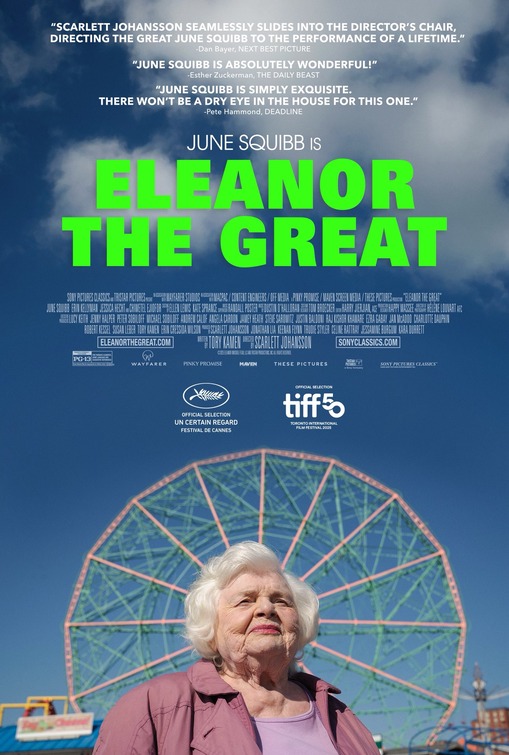
The first time is always the hardest. Eleanor Morgenstein (June Squibb) is a 94 year-old Floridian who has the mental acuity of a 19 year-old. Her days are spent watching people, enjoying good meals, and sometimes antagonizing the local teenagers who work at the place she picks up groceries at. In all of those activities, she’s joined by her best friend, the similarly aged Bessie Stern (Rita Zohar).
Their tie is everlasting, but mortality comes for us all. Bessie faints and sadly passes away. With Eleanor now alone, her daughter, Lisa (Jessica Hecht) moves her back to New York under her and grandson Max’s (Will Price) care, where Eleanor finds difficulty in adjusting to life without her bestie. Encouraged to find a new community of potential friends at the local Jewish Convention Center, she stumbles her way into a Holocaust survivor group, and in the process, shares her story of surviving the Holocaust.
Her story touches many, including young college student Nina (Erin Kellyman), a journalism major still processing the recent loss of her beloved Jewish mother. It’s a death that has put up a wall between Erin and her father, famed NYC newscaster Roger (Chiwetel Ejiofor). Over time, a friendship grows from Nina and Eleanor’s shared losses. The issue is, Eleanor’s touching story doesn’t belong to her, but to the deceased Bessie.

If one needs proof that it’s never too late to level up, June Squibb is right there as exhibit A. Last year’s Thelma was the actresses’ very first leading role, and the simple-yet-stirring dramedy was a wonderful showcase for the then 94-year old. Now at 95, the actress is continuing her mini-renaissance by leading Eleanor the Great, another dramedy that on the surface seemingly has many of the same elements for Squibb to make a streak of quality movies where she’s the clear lead. But through no fault of her own, Eleanor the Great is harder to embrace even as it’s trying so hard to be so moving.
Scarlett Johansson adds director to her CV for the very first time on this film. Shot on-location in New York City, the locale isn’t focused so much on the hustle/bustle energy of the Big Apple. Rather, there’s a smaller, lived-in authenticity that exists in much of the direction, most evident during the scenes where Eleanor is sharing the stories that grip the audience (Johansson was able to have actual Shoah Foundation members sit in). The editing, led by Harry Jierjian, is an important part of the film’s direction, often focusing on the countenance of the titular character’s words before segueing to the actual owner of the stories she’s reciting. A heavy piano found in the score detracts from some of the emotion Johansson works to conjure up though.
Eleanor the Great lives in the morally grey space, openly asking if Eleanor’s loneliness justifies her hurtful dishonesty—clearly done without malice, but knowingly. It’s a question with a definitive answer, and since the answer is so definitive, the open endedness and sparse consequences in writer Tory Kamen’s script feels a little too fluffy and all too eager to brush its titular character’s act under the rug. Setup wise, the movie is reminiscent of Sick Girl, even down to the motivations of why the characters feel inclined to go with such a serious lie, albeit with a little more restraint.
Squibb remains as adept as ever as an on-screen presence. Eleanor the character is far from feeble, which gives Squibb the opportunity to deliver witty lines that occasionally land. That said, her character is missing a complete arc, and it’s hard to say she changes all that much by the movie’s end. Eleanor the Great is at its best emotionally when the feature briefly focuses on the ways Nina and Roger deal with the respective grief and, in Roger’s cause, the reticence to confront it in full. Their relationship ebb and flow and eventual reconciliation tugs at the heartstrings, providing a great showcase for the fresh-faced Kelleyman and a reminder of the talent Ejiofor possesses. During points of the runtime, I was wondering what a movie focused on these two would look like instead of being relegated to largely supporting Eleanor’s existence.
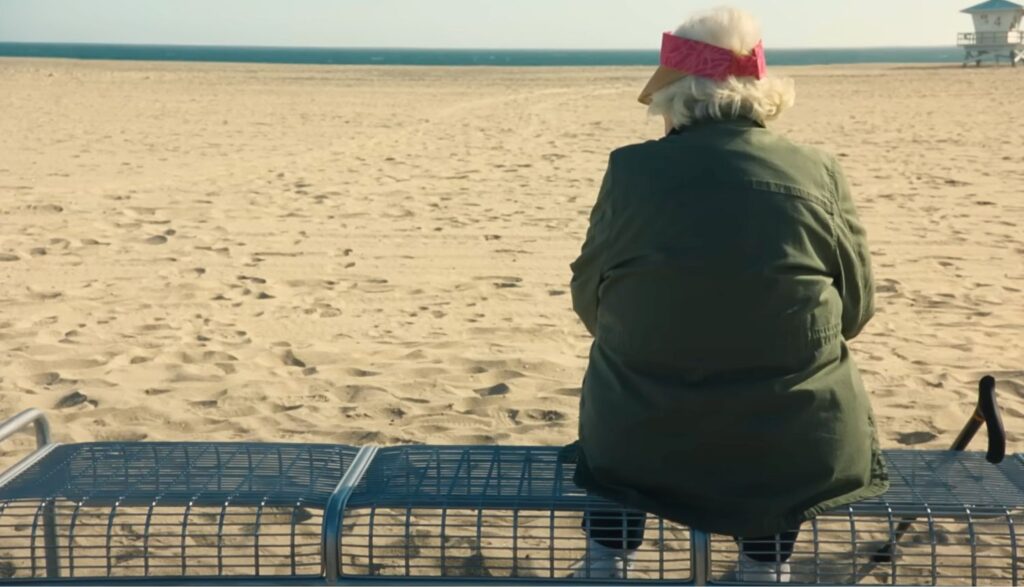
It’s not as easy to blend comedy and drama as some of the best movies make it out to be. In Eleanor the Great, Johansson goes to great lengths to be sprightly and somber. The chutzpah she carries I’m sure may be put to better use in the future, but her debut ends up being too scattershot to be worth thinking about for too long.
C
Photo credits go to sonypictureclassics.com, impawards.com, pluggedin.com, and dailyherald.com.
 MMJ
MMJ 
It is nice to see June in a starring role here – love her work. I do think Scarlett made an interesting (brave?) choice for her directoral debut. Considering who is both in front of and behind the camera, I think I will check this one out even if it sounds uneven.
The last year has been cool to see June evolve into a starring thespian. There is definitely some good to this movie, particularly from the cast; the writing just didn’t click a ton with me.