
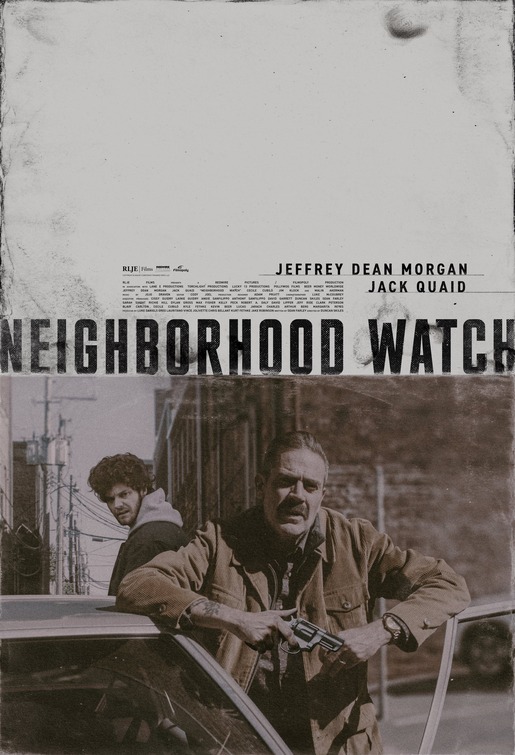
It’s a small world, and an even smaller neighborhood. For a long but indeterminate amount of time, Simon (Jack Quaid) has fought mental illness and addiction, seeing things that aren’t there and perpetually dealing with a voice in his head that reminds him he’s worthless. In Birmingham, Alabama, he lives with his sister, Deedee (Malin Akerman) and is trying to stay on the right path, but the road is challenging each day.
One day walking home from his doctor’s appointment, he’s definitely sure he saw an abduction of a young female in an alleyway. Sharing his report with the police goes nowhere, as Simon isn’t the most reliable of people. Helpless but resolute, he pleads with his next door neighbor, the cantankerous Ed (Jeffrey Dean Morgan) for assistance. Ed remains bitter that he’s no longer employed as a security director by the local college, but can’t let the routine or the power he once had go. Reluctantly, Ed agrees to help Simon, pushing the two makeshift detectives down a path of self-discovery.

Quaid’s busy 2025 continues. After appearing in oft-kilter features in Companion and Novocaine, Neighborhood Watch is…not that, and one might wish it were after viewing. It’s an aggressively average movie.
Following his minor horror/thriller streaming hit in The Clovehitch Killer, director Duncan Skiles’ second film is less psychological and more straightforward. Shot in 18 days across Alabama cities, there’s a workmanlike, no-frills aesthetic to the production. Skiles is very content to let the direction be very secondary to his two stars, but does portray what appears to be schizophrenia and crushing self-doubt in a respectful yet visually notable way. While the direction is intentionally muted and bare—sometimes to a detriment, the score is anything but, and that’s not a good thing. It’s hard to know what vibe composer Jojo Draven is aiming for.

It’s also hard to know what Neighborhood Watch’s script, written by first-time writer Sean Farley, is going for. The tone swings back and forth between breezy and heavy, especially as the story gets more entrenched in the latter as Simon and Ed go deeper into the proverbial criminal rabbit hole. Still, they operate with a whimsicality that is pleasant to see, but incongruous to others in the movie, and the plot they move within lacks danger stakes given the revealed subject matter. Perhaps a wiser move may have been to lower the crime stakes, lean into the comedic, and have the duo find common ground solving more misdemeanor-like crimes, eventually using their newfound confidence to move their lives forward. Not impossible to juggle these differing vibes, but difficult for a less experienced writer.
Even if they feel like they’re in a different film, Quaid and Morgan do share a likable chemistry together, and the way their respect for each other evolves is endearing. That said, their characters aren’t as fleshed out as it appears they would be, and the rest of the features does little of importance to showcase other characters, be it Akerman as the stressed-out sister, or Cecile Cubiló as a law enforcement officer who predictably is one step behind Simon as Ed as they put the pieces together to the mystery.

There’s a memorable movie somewhere in Neighborhood Watch. As it is though, more riveting footage is likely to be found on a surveillance tape at the local convenience store.
C-
Photo credits go to screenrant.com, impawards.com, and variety.com.
 MMJ
MMJ 