
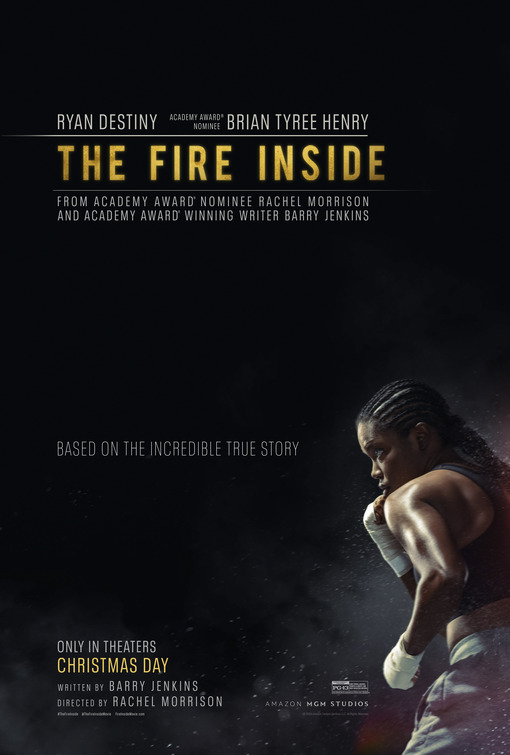
Where do you go when the medal is won? Flint, Michigan is the home of Claressa Shields (Ryan Destiny). Known as “Ressa” and “T-Rex” (latter due to short arms), she has taken up boxing at an early age and quickly displayed proficiency with the sweet science under the tutelage of coach and father figure Jason (Brian Tyree Henry).
Her actual home is a chaos pool. Ressa’s negligent mother (Oluniké Adeliyi) prioritizes her own wants over her daughter’s and siblings’ needs. A blow up between the two puts Ressa out on the streets, with nowhere to go but under the roof of Jason. All of this comes at the worst time, as the teen is knee deep into training for the 2012 Olympics. If she can compartmentalize all of this, winning the gold medal should change her life and the lives of her loved ones, opening her up to more endorsements, attention, and life-changing money. Or at least that’s what common sense would suggest.

Most boxing movies follow some form of a rise, fall, rise structure. It’s what we love about them while also acknowledging they can be extremely formulaic. But with The Fire Inside, it’s hard to call it a true boxing movie, especially when you realize that the ring action is pretty sparse. The unorthodox approach relative to the subgenre makes it a watch that takes some time getting accustomed to, but the choice allows the cold reality to sink in so much more.
For years, Rachel Morrison has contributed cinematography efforts in notable films such as Mudbound and Black Panther. With The Fire Inside, she gets her first opportunity to spearhead a feature film. The director is much more interested in the external factors growing up in Flint and being an African-American female Ressa has to contend with compared to the actual fighting dynamics of the sport. Her “rise” is almost utilitarian in the way it’s shot, like a formality that Morrison and co. are just waiting to get through before the movie really begins.

Morrison and writer Barry Jenkins (back to his roots here) build the movie around what happens, or in actuality, what doesn’t happen, after Ressa reaches the mountaintop. One of the choices the duo make after the mid-feature climax is immediately returning to Flint mere months later, using establishing shots and showing the lead character back in what essentially is a depressing reality. Becoming an Olympian and finishing on the top podium grants nothing. What you win a medal in, and the role your race and gender play in marketability does. Jenkins and Morrison commit most of the 2nd half to this, which follows Ressa and Jason bumping up against the system to fight and claw for every minor win and monetary gain.
Screenwriter and director do a great job at characterizing the two focal points of the story, but they come up short in pacing the story effectively and progressing character relationships in a believable way. Take Ressa and her mother, where the movie quickly moves from Ressa being kicked out by her mom, to her mom cheering her on with others in Flint while she’s at the Olympics, and then her and her mom back in a good relationship post gold medal, with no moment of reconciliation shown. Since all of this happening in a short amount of runtime, it gives The Fire Inside a feeling of whiplash.
Still, The Fire Inside is rooted around Claressa and her coach. The role of Ressa gives Detroit native Destiny a foundation to use this as a launching pad, believable with the physical aspects but more importantly, she ebbs and flows nicely with the movie’s ebb and flow in story focus, transforming from a relentlessly driven individual determined to achieve her goal to someone trying to deal with the frustration of coming back to the same life she had pre-accolades. Henry turns in one of the more underappreciated and underseen supporting performances of 2024, providing the fatherly figure Ressa is missing while drawing the motivation needed out of his fighter to keep her pushing.
Tweaking the normal structure for a boxing movie makes The Fire Inside less of one. But what it loses in well-staged pugilism and feeling like a boxing movie, it makes up for in being a more than passable biopic.
B
Photo credits go to rottentomatoes.com, impawards.com, IMDB.com, and indiewire.com.
 MMJ
MMJ 