
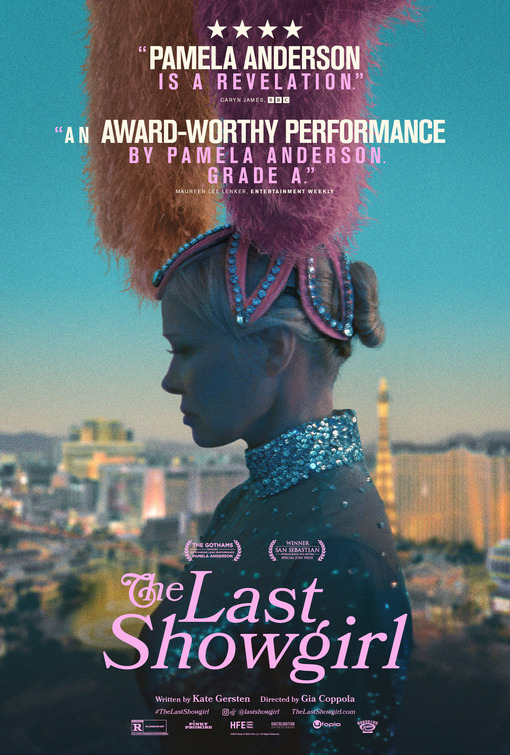
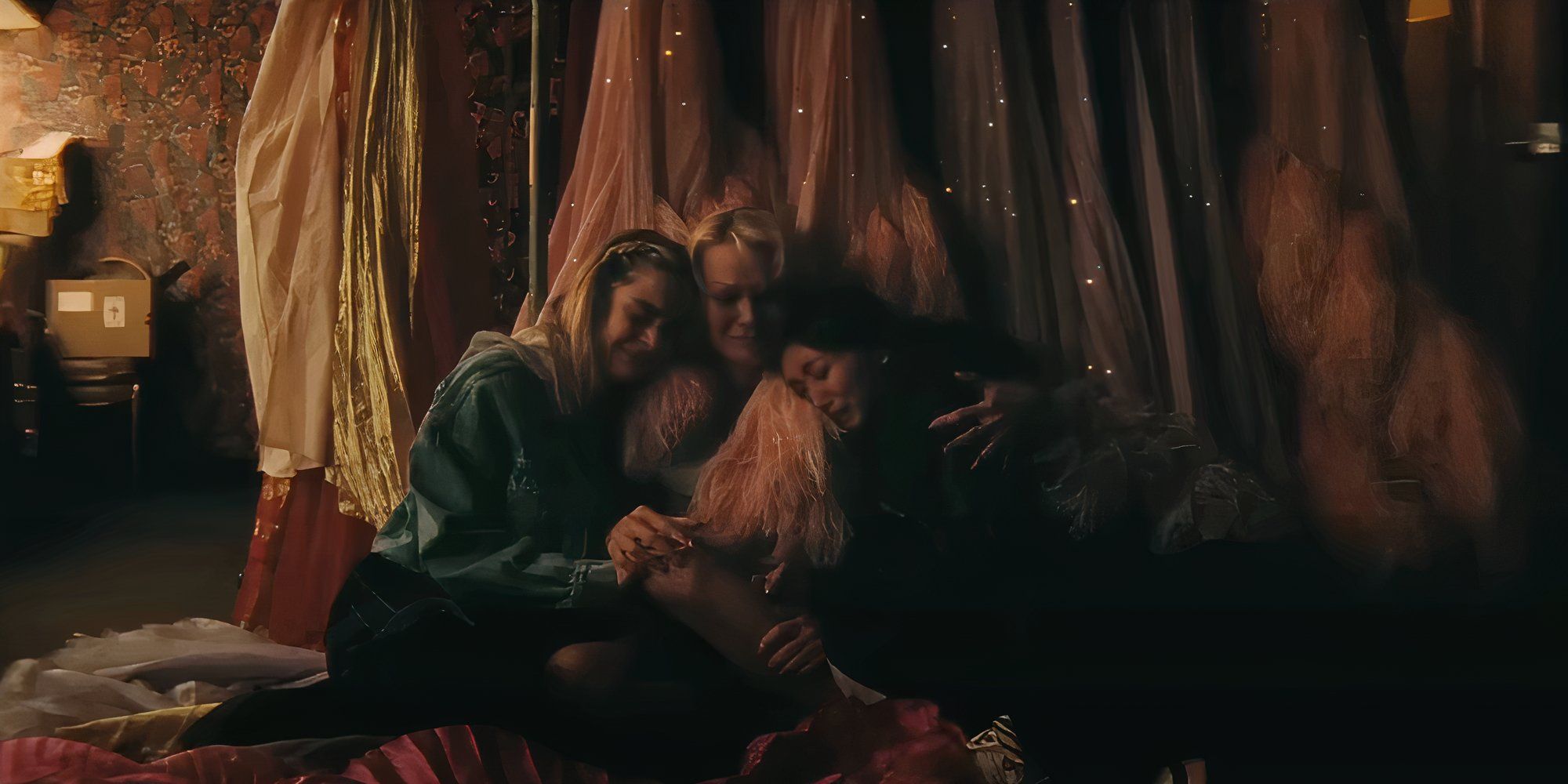
All stars fizzle out eventually, the only question is whether they’re able to exit gracefully or abruptly. For Shelly (Pamela Anderson), her entire life over the past 30 years has been as a showgirl in Las Vegas, performing in a famous show known as “Le Razzle Dazzle.” Crowds have come and gone, and so too have fellow showgirls, but she’s remained. She’s now seen as a mother hen in the eyes of youngsters Jodie (Kiernan Shipka) and Mary-Anne (Brenda Song), and a coach on stage for the proverbial eye in the sky, stage manager Eddie (Dave Bautista).
Unfortunately, a steady downturn in attendance prompts the closure of Shelly’s act, and she along with the other showgirls have two weeks to go before the curtain calls for good. As Shelly wrestles with indecision about her future, she’s forced to reconcile with her past as her estranged daughter, Hannah (Billie Lourd) re enters her life.

When the year of 2024 is officially wrapped up for movies and re-examined years and ages later, perhaps it’ll be remembered for the year that so many—for lack of a better adjective—old actresses got a chance not just to appear, but even carry good to great features. Whether Demi Moore to Nicole Kidman, or Marianne Jean-Baptiste to June Squibb, the super-seasoned actress is having a moment. You can add the 57-year-old Pamela Anderson to the list. While her turn in The Last Showgirl isn’t quite to the level of those aforementioned counterparts, she extracts as much out of the script and direction to turn in a notable performance.
The Last Showgirl is the third film from Gia Coppola, and the first one that she has not written. Aesthetically, it’s very different from her previous flick, 2020’s middling modern mocking of viral celebrity in Mainstream. Her direction here abundantly uses 16mm film to evoke the old-timey vibe that these carny-like acts invite, and some of the shots her and cinematographer Autumn Durald Arkapaw use of Las Vegas deliberately show Sin City as a washed out, depression-inducing metropolis where dreams either die on impact or the illusion of stardom keeps people chasing the golden nugget. Oddities in camera focus are found here, and it can be a bit distracting and reminiscent of seeing someone on Zoom who has blurred their background.

Making her feature-length writing debut on The Last Showgirl is Kate Gersten. Clocking in at just under 90 minutes, her script is very interested in aging and specifically what happens specifically to one-time starlets when the system that once propped them up is beyond ready to chew and spit them out for something younger and sexier. Valid story comparisons to this and The Substance have been made. In all of its excess though, the Moore-led film was paced well and—rather forcibly (obviously)—had its core character(s) undergo noticeable change.
By the time The Last Showgirl ends, it’s difficult to ascertain how Shelly has evolved or even an inkling to how she will. We get a lot of dialogue that meanders and actively lessens the interest of its lead character, who by the end comes off as unbelievably oblivious. If there were ever a movie that really needed to show more than tell for its main character, it would be this one. Even just a sole two-to-three minute wide shot, unbroken sequence of seeing Shelly perform in Le Razzle Dazzle would have worked wonders to understand what the show means to her and her place in it.
With the character of Shelly and subsequent casting of Anderson, Coppola leans into a meta aspect that maybe does little for the in-movie character, but does a lot for the audience if we imagine Shelly as a sort-of fictionalized version of Anderson. The actress taps into a personal place of industry wariness and the fears of being pushed aside for the next young thing, and feelings of catharsis and sadness definitely come across in the feature. But I wonder if the movie would be better if Anderson was part of an ensemble approach, because the efforts of Bautista, Shipka, Song, and Jamie Lee Curtis don’t shine like they should. These are all interesting characters who stand out in brief doses, yet as constructed don’t get a lot to do.
At the bare minimum, The Last Showgirl should be a foundational first step towards a new act of Anderson’s career, because there definitely is something here that sharp writers and filmmakers can utilize well. As far as this feature goes, I think I would have liked the film better if its writing were tweaked and titled changed to something like “The Last Curtain Call.“
C+
Photo credits go to IMDB.com, screenrant.com, and impawards.com.
 MMJ
MMJ 