

When things are good, that’s when the bad stuff happens. Right now, life is a lot of mundane stuff for Frida (Naomi Ackie). She works a thankless job as a hostess alongside roommate Jess (Alia Shawkat). But Frida has dreams of being seen, and she plots her opportunity around billionaire tech CEO Slater King (Channing Tatum), who is having a fundraising gala that Frida and Jess are working. By “forced” chance, Frida ends up in the orbit of the mogul. They hit it off, and her along with Jess are invited to a getaway at the island owned by Slater, his safe haven of sorts after coming under fire for inappropriate behavior that became the impetus in stepping down from his company. Joining them are some of Slater’s work compadres and early life friends, which include Vic (Christian Slater), Cody (Simon Rex), Lucas (Levon Hawke), and Tom (Haley Joel Osment), along with other women such as Sarah (Adria Arjona), a television reality star who has found success on a Survivor show of sorts.
When they touch down on the lush island, everything is awesome. The food is exquisite, the drugs sensational, and the vibes all around immaculate. It’s a summer party, and the experiences Frida and Jess are making surpass anything they’d be doing back home. After the fun days and nights have fused together, they begin to get the feeling that something is very, very wrong with this setup. The only question is if it’s too late to do anything about it.

Regardless of who they are, not every debut director can come out of the gates with an widely accepted classic. Hell, you can argue if it’s in their best interest to do so, as the pressure to live up to it in subsequent releases probably wouldn’t be the easiest to manage. For Zoë Kravitz, the first movie she’s cut her teeth on as a director in Blink Twice will not go down as something she’ll never be able to top.
Kravitz’s potential is most evident behind the lens. The best adjective for her film may be vivid. In partnership with cinematographer Adam Newport-Berra, color serves as acute storytelling markers (particularly the color red as an anchor point for passion, power, and desire, along with stark white as a theme for elitism), and so too are the usages of animals like snakes and bunnies. Perhaps by osmosis, her being around music and music videos her entire life by way of her famous artist father helps in giving her feature a perpetual kinesis, especially during the first half. An steady undercurrent of tension exists through it all.

After thinking more after viewing Blink Twice, I come away with two main acknowledgements/admissions. One: It has stuck with me, which usually means that the movie was effective in provoking deeper thought. But when I peel back the union, my realization was that Kravitz’s movie is still on my mind because of the viscerally uncomfortable places she chooses to go, and not because of the effectiveness of her story, co-written by her and E.T. Feigenbaum.
To be fair, Blink Twice isn’t meant to be 100% literal; it’s clear Kravitz is using the story as an approximate for Jeffrey Epstein’s misdeeds, gender power dynamics, and our willingness as a collective in today’s modern world to forget wrongdoings. Interesting ideas, but these need a cohesive script to make them stick, as the movie operates in a mostly realistic setting. And sometimes cohesion can be as simple as making sure the logistics (in this instance of the setting and physiological variety) don’t prompt more questions than answers. It all leads to a ending that does take a big swing—and count me in on those on the side of the fence who thinks it works as an idea—but again falls under logistical scrutiny. Additionally, it doesn’t help when the tone vibrates from firmly comedic to grotesquely heavy in the span of seconds.
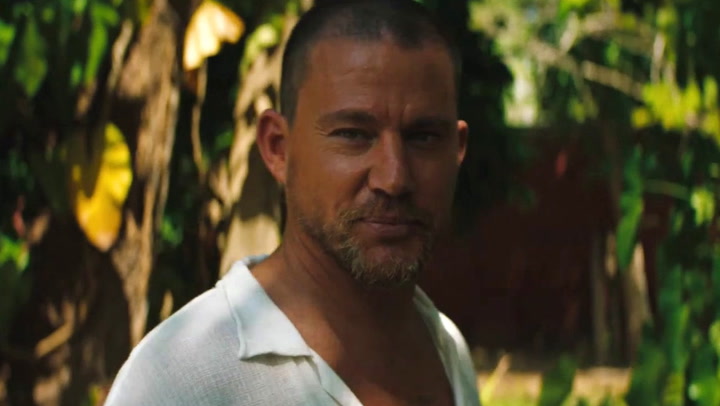
In Blink Twice, Kravitz has assembled a cast of established vets and up-and-comers. Somewhat fitting to the matriarchal and patriarchal themes of the feature, it is the men in the movie who are the ones we’re familiar with, such as Osment, Rex, Slater, Kyle MacLachlan and of course Tatum. Aside from Tatum, this is a cast of characters whose names or defining characteristics are nonexistent, and it doesn’t feel like Kravitz is overly concerned with giving these people any defined lines. The women the director casts (save for Geena Davis, playing a bit against mission type) possess less of a historical factor to them, which does allow them to be better vessels for the horrors when Blink Twice is operating at its best. Of the prominent female cast members, Arjona shines the brighter of the two. There’s a magnetism and fierceness present in her that didn’t come across the same way for Ackie, and I wonder if the events of the finale feel more believable with the two actresses swapping roles.
At minimum, you want a debut director to show they’ve got potential and the ability to tell challenging stories, and in the case of Blink Twice—we get that. Let’s just hope that in the future, Kravitz’s movies can better marry the intent of having a good time with meaningful, clearer story plotting.
C
Photo credits go to independent.co.uk, IMDB.com, and variety.com.
 MMJ
MMJ 
The film begins with an atmosphere of darkness and mystery, gradually building tension, but ultimately devolves into a brutal and visceral revenge-driven slasher. Too bad it had promise.
Yes, sorry been way too busy lately! I am intrigued to see what Zoe does next because the visual skill is clearly evident but the writing is going to need some seasoning.